
The God Who Dwells Among Us - Exodus 40
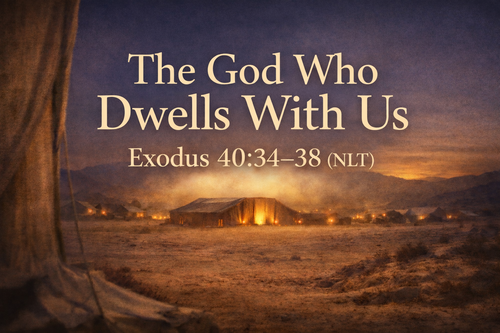
Rooted in the Word – Week 5
February 1, 2026A Word Before We Begin
If you are reading this rather than hearing it preached in worship, it likely means that circumstances beyond our control—weather, safety, or the unpredictability of winter—have kept us from gathering in person. What follows is the Scripture and the message I would be preaching this Sunday if we were able to gather for worship together.
While we may be separated by distance, we are not separated from the story we are telling together, nor from the God who meets us wherever we are.
This message is part of our shared journey through Scripture—a year-long walk through the Bible as a unified story that leads us to Jesus. Even when we cannot gather in the same room, that story continues. God continues to speak. And God continues to dwell with His people.
So, wherever you are as you read—at a kitchen table, in a quiet living room, or perhaps with snow falling outside—take a moment to slow down. This is not just a message to be read, but an invitation to reflect on the God who chooses to be present with us.
While we may be separated by distance, we are not separated from the story we are telling together, nor from the God who meets us wherever we are.
This message is part of our shared journey through Scripture—a year-long walk through the Bible as a unified story that leads us to Jesus. Even when we cannot gather in the same room, that story continues. God continues to speak. And God continues to dwell with His people.
So, wherever you are as you read—at a kitchen table, in a quiet living room, or perhaps with snow falling outside—take a moment to slow down. This is not just a message to be read, but an invitation to reflect on the God who chooses to be present with us.
The Story So Far
Over these past weeks, we have been retracing the great arc of Scripture together. We began in the beginning—with light—with a God who creates human beings in His own image and intends that divine light to be reflected in and through them.
But it did not take long for that light to bend inward. At the tower of Babel, human beings attempted to secure their future on their own terms. And yet, in grace, God came down—not to abandon humanity, but to redirect the story toward His redemptive purposes. And throughout Scripture, this pattern continues: God comes down.
We then stood with Abram beneath a sky filled with stars and heard God make a promise that stretched beyond imagination and beyond a single lifetime. Though it took generations to unfold, that promise did not fail.
Last week, we stood on holy ground as God met Moses in the burning bush—calling him by name and revealing once again that God hears the cries of His people. What was ordinary became holy, simply because God was present.
From there, the story accelerates. God confronts Pharaoh. Chains are broken. The sea parts. A people are set free. And in the wilderness, God begins shaping Israel—not merely as survivors, but as a people who bear His name and are called to reflect His light into the world.
And now, we arrive near the end of the book of Exodus.
Over these past weeks, we have been retracing the great arc of Scripture together. We began in the beginning—with light—with a God who creates human beings in His own image and intends that divine light to be reflected in and through them.
But it did not take long for that light to bend inward. At the tower of Babel, human beings attempted to secure their future on their own terms. And yet, in grace, God came down—not to abandon humanity, but to redirect the story toward His redemptive purposes. And throughout Scripture, this pattern continues: God comes down.
We then stood with Abram beneath a sky filled with stars and heard God make a promise that stretched beyond imagination and beyond a single lifetime. Though it took generations to unfold, that promise did not fail.
Last week, we stood on holy ground as God met Moses in the burning bush—calling him by name and revealing once again that God hears the cries of His people. What was ordinary became holy, simply because God was present.
From there, the story accelerates. God confronts Pharaoh. Chains are broken. The sea parts. A people are set free. And in the wilderness, God begins shaping Israel—not merely as survivors, but as a people who bear His name and are called to reflect His light into the world.
And now, we arrive near the end of the book of Exodus.
Scripture Reading: Exodus 40:30–38 (New Living Translation)
Moses placed the washbasin between the Tabernacle and the altar. He filled it with water so the priests could wash themselves. Moses and Aaron and Aaron’s sons used water from it to wash their hands and feet. Whenever they approached the altar and entered the Tabernacle, they washed themselves, just as the LORD had commanded Moses.
Then Moses hung the curtains forming the courtyard around the Tabernacle and the altar. And he set up the curtain at the entrance of the courtyard. So at last Moses finished the work.
Then the cloud covered the Tabernacle, and the glory of the LORD filled the Tabernacle. Moses could no longer enter the Tabernacle because the cloud had settled down over it, and the glory of the LORD filled the Tabernacle.
Now whenever the cloud lifted from the Tabernacle, the people of Israel would set out on their journey, following it. But if the cloud did not rise, they remained where they were until it lifted. The cloud of the LORD hovered over the Tabernacle during the day, and at night fire glowed inside the cloud so the whole family of Israel could see it. This continued throughout all their journeys.
The Awe of God’s Presence
Then Moses hung the curtains forming the courtyard around the Tabernacle and the altar. And he set up the curtain at the entrance of the courtyard. So at last Moses finished the work.
Then the cloud covered the Tabernacle, and the glory of the LORD filled the Tabernacle. Moses could no longer enter the Tabernacle because the cloud had settled down over it, and the glory of the LORD filled the Tabernacle.
Now whenever the cloud lifted from the Tabernacle, the people of Israel would set out on their journey, following it. But if the cloud did not rise, they remained where they were until it lifted. The cloud of the LORD hovered over the Tabernacle during the day, and at night fire glowed inside the cloud so the whole family of Israel could see it. This continued throughout all their journeys.
The Awe of God’s Presence
After months of careful obedience—after gathering gold, linen, and acacia wood—Israel completes the Tabernacle: a portable place of meeting for the LORD. And as soon as the work is finished, God shows up.
The book of Exodus tells us:
“Then the cloud covered the Tabernacle, and the glory of the LORD filled the Tabernacle.”
The Hebrew word for glory—kabod—means weight or substance. This is not a vague or symbolic presence. It is the tangible, overwhelming reality of God’s holiness filling the space.
This is no casual moment. God’s presence settles with holy gravity. It inspires awe—the kind that quiets voices and stills hearts.
This is the same God who spoke creation into being. The same God who walked with Adam and Eve in the garden. The same God who told Abram to look up and try to count the stars. The same God who called Moses from the flames and descended upon Mount Sinai in fire and thunder.
And now, that same God comes to dwell right in the middle of His people.
God’s Glory and God’s Grace
Here we encounter a stunning paradox. The God who created galaxies and oceans—the God of infinite glory—chooses to live in a tent.
God does not dwell in the palaces of Pharaoh. He does not hide Himself in some distant heavenly realm. Instead, He moves directly into the center of the camp, surrounded by ordinary, wandering, imperfect people.
This is grace on full display.
As we read these early stories of Scripture, one truth appears again and again: God desires to be with His people. Even when humanity chooses paths of sin and rebellion, God continues to make a way.
More than that, God does not merely dwell near His people—He leads them. Exodus tells us that whenever the cloud lifted from the Tabernacle, Israel would set out on their journey. When it remained, they stayed where they were.
God’s presence is not static. It is dynamic. The God who comes down is also the God who goes with His people.
The Glory and the Tension
There is, however, a detail at the very end of Exodus that is easy to miss. When the Tabernacle is complete and the glory of the LORD fills it, Moses cannot enter.
This is the same Moses who stood before Pharaoh. The one who climbed the mountain. The one who spoke with God amid fire and cloud. And yet, even Moses stands outside.
The book ends here. God is there—right in the middle of the camp. And yet, no one can enter. God is near enough to follow, but not yet close enough to embrace.
That tension matters. God is closer than ever before, and still something stands in the way. The story leaves us waiting—wondering—hoping that this cannot be the end.
Because if this is where the story stops, then God can dwell near His people, but not fully with them in the relationship He desires.
The book of Exodus tells us:
“Then the cloud covered the Tabernacle, and the glory of the LORD filled the Tabernacle.”
The Hebrew word for glory—kabod—means weight or substance. This is not a vague or symbolic presence. It is the tangible, overwhelming reality of God’s holiness filling the space.
This is no casual moment. God’s presence settles with holy gravity. It inspires awe—the kind that quiets voices and stills hearts.
This is the same God who spoke creation into being. The same God who walked with Adam and Eve in the garden. The same God who told Abram to look up and try to count the stars. The same God who called Moses from the flames and descended upon Mount Sinai in fire and thunder.
And now, that same God comes to dwell right in the middle of His people.
God’s Glory and God’s Grace
Here we encounter a stunning paradox. The God who created galaxies and oceans—the God of infinite glory—chooses to live in a tent.
God does not dwell in the palaces of Pharaoh. He does not hide Himself in some distant heavenly realm. Instead, He moves directly into the center of the camp, surrounded by ordinary, wandering, imperfect people.
This is grace on full display.
As we read these early stories of Scripture, one truth appears again and again: God desires to be with His people. Even when humanity chooses paths of sin and rebellion, God continues to make a way.
More than that, God does not merely dwell near His people—He leads them. Exodus tells us that whenever the cloud lifted from the Tabernacle, Israel would set out on their journey. When it remained, they stayed where they were.
God’s presence is not static. It is dynamic. The God who comes down is also the God who goes with His people.
The Glory and the Tension
There is, however, a detail at the very end of Exodus that is easy to miss. When the Tabernacle is complete and the glory of the LORD fills it, Moses cannot enter.
This is the same Moses who stood before Pharaoh. The one who climbed the mountain. The one who spoke with God amid fire and cloud. And yet, even Moses stands outside.
The book ends here. God is there—right in the middle of the camp. And yet, no one can enter. God is near enough to follow, but not yet close enough to embrace.
That tension matters. God is closer than ever before, and still something stands in the way. The story leaves us waiting—wondering—hoping that this cannot be the end.
Because if this is where the story stops, then God can dwell near His people, but not fully with them in the relationship He desires.
Glory Fulfilled in Christ
Centuries later, that same glory appears again—not in a tent, but in a person. We can read about this foundational event in Matthew 17:1-9.
Centuries later, that same glory appears again—not in a tent, but in a person. We can read about this foundational event in Matthew 17:1-9.
Six days later Jesus took Peter and the two brothers, James and John, and led them up a high mountain to be alone. As the men watched, Jesus’ appearance was transformed so that his face shone like the sun, and his clothes became as white as light. Suddenly, Moses and Elijah appeared and began talking with Jesus.
Peter exclaimed, “Lord, it’s wonderful for us to be here! If you want, I’ll make three shelters as memorials[a]—one for you, one for Moses, and one for Elijah.”
Peter exclaimed, “Lord, it’s wonderful for us to be here! If you want, I’ll make three shelters as memorials[a]—one for you, one for Moses, and one for Elijah.”
But even as he spoke, a bright cloud overshadowed them, and a voice from the cloud said, “This is my dearly loved Son, who brings me great joy. Listen to him.” The disciples were terrified and fell face down on the ground.
Then Jesus came over and touched them. “Get up,” he said. “Don’t be afraid.” And when they looked up, Moses and Elijah were gone, and they saw only Jesus. As they went back down the mountain, Jesus commanded them, “Don’t tell anyone what you have seen until the Son of Man has been raised from the dead.” (Matthew 17:1-9)
For a brief moment on a mountain, the glory of the LORD shines so brightly in Jesus that His disciples fall to the ground in fear. Once again, God’s holiness overwhelms human beings.
But then something new happens.
Jesus comes to them. He touches them. And He says, “Get up. Do not be afraid.” When they look up, the glory has faded—but Jesus remains.
That moment is not yet the solution, but it is a promise: a promise that one day God’s glory would no longer keep people out, but would draw them in.
At the cross, that promise comes into full view. What Moses could not enter, Christ enters on our behalf. What once stood between God and His people is taken up and carried by Jesus Himself.
And so, the story moves—from God dwelling among His people to God dwelling within His people.
A Closing Word
Even if we cannot gather for worship today, this truth remains:
The God who filled the Tabernacle with glory has not withdrawn from His people. By grace, through Christ, God continues to dwell with us—and within us—wherever we are. May that truth steady your heart, guide your steps, and remind you that no storm can keep God at a distance.
Prayer
Grace and peace,
Aaron Atchley
Pastor, Gray United Methodist Church
But then something new happens.
Jesus comes to them. He touches them. And He says, “Get up. Do not be afraid.” When they look up, the glory has faded—but Jesus remains.
That moment is not yet the solution, but it is a promise: a promise that one day God’s glory would no longer keep people out, but would draw them in.
At the cross, that promise comes into full view. What Moses could not enter, Christ enters on our behalf. What once stood between God and His people is taken up and carried by Jesus Himself.
And so, the story moves—from God dwelling among His people to God dwelling within His people.
A Closing Word
Even if we cannot gather for worship today, this truth remains:
The God who filled the Tabernacle with glory has not withdrawn from His people. By grace, through Christ, God continues to dwell with us—and within us—wherever we are. May that truth steady your heart, guide your steps, and remind you that no storm can keep God at a distance.
Prayer
Holy and gracious God,
You fill heaven and earth with Your glory, and yet You choose to dwell with us. Thank You for the cloud that reminds us of Your holiness, and for the cross that reveals Your mercy. Wherever we are today, dwell with us once more. Fill our hearts as You once filled the Tabernacle. Lead us by Your Spirit and teach us to walk in awe and love.
Amen.
Grace and peace,
Aaron Atchley
Pastor, Gray United Methodist Church
Posted in Pastor Notes
Categories
Recent
Archive
2026
January
Week 1, Day 1: Genesis 1-3, Psalm 1Week 1: January 1-3Week 1, Day 2: Genesis 4-7, Psalm 2Week 1, Day 3: Genesis 8-11, Psalm 3Week 2, Day 4: Genesis 12-15, Psalm 4Week 2: January 4 - 10Week 2, Day 5: Genesis 16-18, Psalm 5Week 2, Day 6: Genesis 19-21, Psalm 6Week 2, Day 7: Genesis 22-24, Psalm 7Week 2, Day 8: Genesis 25-28, Psalm 8 Week 2, Day 9: Genesis 29-31, Psalm 9 Week 2, Day 10: Genesis 32-34, Psalm 10Week 3: January 11-17Week 3, Day 11: Genesis 35-37, Psalm 11Week 3, Day 12: Genesis 38-40; Psalm 12Week 3, Day 13: Genesis 41-42, Psalm 13Week 3, Day 14: Genesis 43-45; Psalm 14Week 3, Day 15: Genesis 46-47; Psalm 15Week 3, Day 16: Genesis 48-50; Psalm 16Week 3, Day 17: Exodus 1-3; Psalm 17Week 4: January 18-24Week 4, Day 18: Exodus 4-6; Psalm 18Week 4, Day 19: Exodus 7-9; Psalm 19Week 4, Day 20: Exodus 10-12; Psalm 20Week 4, Day 21: Exodus 13-15; Psalm 21Week 4, Day 22: Exodus 16-18; Psalm 22Week 4, Day 23: Exodus 19-21; Psalm 23Week 4, Day 24: Exodus 22-24; Psalm 24Week 5, Day 25: Exodus 25-27; Psalm 25Week 5: January 25-31Reading the Bible as a Journey, Not a Puzzle to SolveWeek 5, Day 26: Exodus 28-29, Psalm 26Week 5, Day 27: Exodus 30-31, Psalm 27Week 5, Day 28: Exodus 32-34, Psalm 28Where Are We Putting Our RootsWeek 5, Day 29: Exodus 35-40, Psalm 29Week 5, Day 30: Leviticus 1-4, Psalm 30Leviticus Still MattersWeek 5, Day 31: Leviticus 5-7; Psalm 31The God Who Dwells Among Us - Exodus 40
February
Week 6, Day 32: Leviticus 8-10; Psalm 32Week 6: February 1-7Worship and Sunday School CancelledWeek 6, Day 33: Leviticus 11-13; Psalm 33Week 6, Day 34: Leviticus 14-15; Psalm 34Be Holy For I Am Holy (Leviticus 11:44; 1 Peter 1:13-16)Week 6, Day 35: Leviticus 16-18; Psalm 35Week 6, Day 36: Leviticus 19-20; Psalm 36Week 6, Day 37: Leviticus 21-23; Psalm 37Week 6, Day 38: Leviticus 24-25, Psalm 38Week 7, Day 39: Leviticus 26-27; Psalm 39Week 7: February 8-14Week 7, Day 40: Numbers 1-4; Psalm 40Week 7, Day 41: Numbers 5-7; Psalm 41Week 7, Day 42: Numbers 8-10; Psalm 42A Little Help with Leviticus and NumbersWeek 7, Day 43: Numbers 11-13; Psalm 43Deep Roots Yield a Fruitful FutureWeek 7, Day 44: Numbers 14-16; Psalm 44Week 7, Day 45: Numbers 17-18; Psalm 45Week 8: February 15-21Week 8, Day 46: Numbers 19-21; Psalm 46Announcement Sheet - February 15, 2026Week 8, Day 47: Numbers 22-24; Psalm 47Week 8, Day 48: Numbers 25-27; Psalm 48Week 8, Day 49: Numbers 28-30; Psalm 49Week 8, Day 50: Numbers 31-32; Psalm 50Week 8, Day 51: Numbers 33-34; Psalm 51Week 8, Day 52: Numbers 35-36; Psalm 52Week 9: February 22-28Week 9, Day 53: Deuteronomy 1-3; Psalm 53Announcement Sheet - February 22, 2026Week 9, Day 54: Deuteronomy 4-6; Psalm 54Week 9, Day 55: Deuteronomy 7-9; Psalm 55 Week 9, Day 56: Deuteronomy 10-12; Psalm 56Week 9, Day 57: Deuteronomy 10-12; Psalm 57Week 9, Day 58: Deuteronomy 13-14; Psalm 58Week 9, Day 59: Deuteronomy 17-20; Psalm 59Announcement Sheet - March 1, 2026
March
Week 10, Day 60: Deuteronomy 21-23; Psalm 60Week 10: March 1-7Week 10, Day 61: Deuteronomy 24-27; Psalm 61Week 10, Day 62: Deuteronomy 28-29; Psalm 62Week 10, Day 63: Deuteronomy 30-31; Psalm 63Week 10, Day 64: Deuteronomy 32-34; Psalm 64Week 10, Day 65: Joshua 1-4; Psalm 65Week 10, Day 66: Joshua 5-8; Psalm 66Announcement Sheet - March 8, 2026Week 11: March 8-14Week 11, Day 67: Joshua 9-12; Psalm 67Week 11, Day 68: Joshua 13-21; Psalm 68Week 11, Day 69: Joshua 22-24; Psalm 69Week 11, Day 70: Judges 1-3; Psalm 70Week 11, Day 71: Judges 4-5; Psalm 71Week 11, Day 72: Judges 6-8; Psalm 72Week 11, Day 14: Judges 9-12; Psalm 73Announcement Sheet - March 15, 2026Week 12, Day 74: Judges 13-15; Psalm 74Week 12: March 15-21Week 12, Day 75: Judges 16-18; Psalm 75
3 Comments
I'd love for you to share your reflections and questions here!
Thanks for sharing Aaron. I love how we are continuously reminded that God IS WITH US. No matter the place or circumstance, He IS there.
I feel God is always seeking a relationship between us. He shows us love, grace and mercy. He protects us in the wilderness. He shows us his authority and character. He shows us that we can count on him.